
Validating Real-Time Safety: AI Violence Detection Prototype
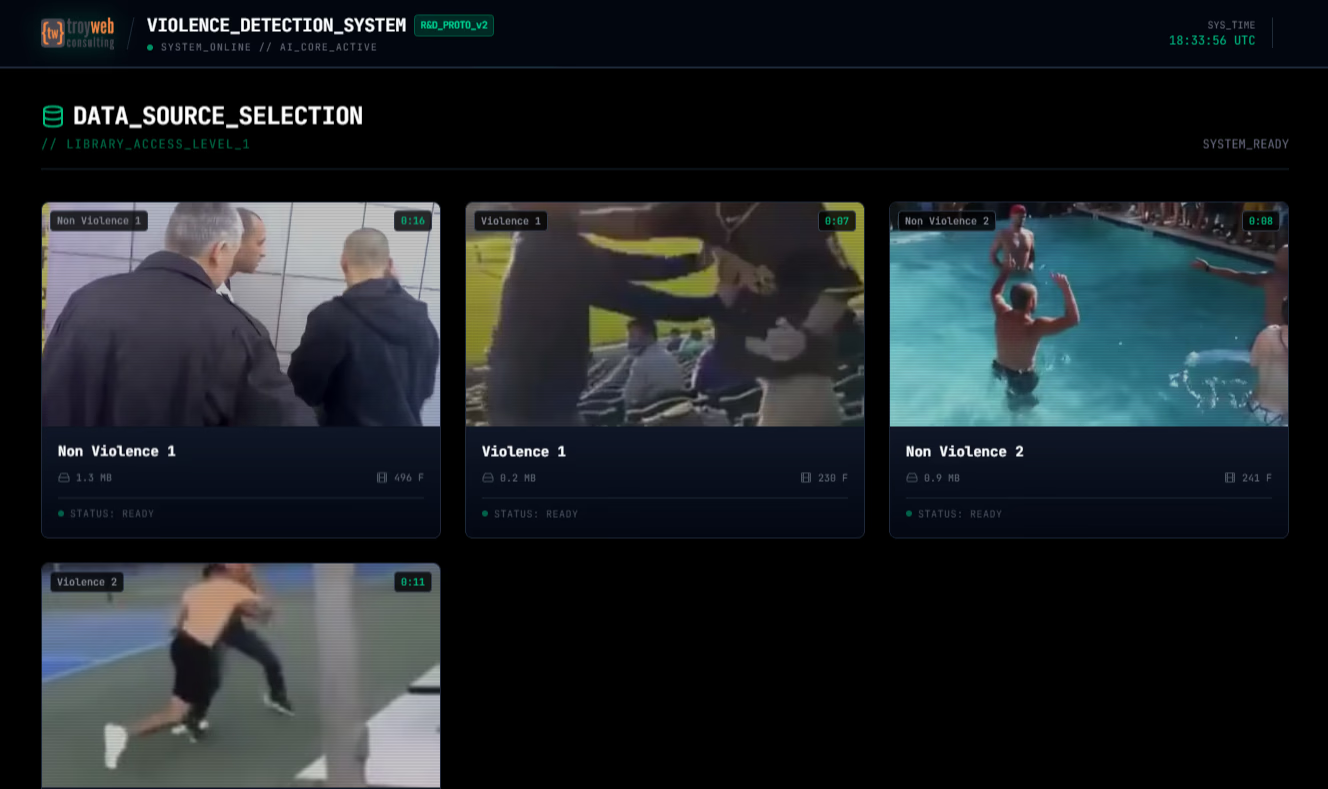
Can a machine distinguish between a high-five and a physical altercation? We brought this question to The Lab to experiment on which resulted in a functional Computer Vision prototype.
Services Provided
- Custom Application Development
- Data & Analytics
Industries
- Education
- Government
85%
Accuracy Rate
Achieved by fine-tuning pre-trained models, providing a reliable "first line of defense".
24
Frames Per Sample
Optimized data extraction to capture motion patterns without overloading system processing.
Zero-Risk
Implementation
Developed entirely within The Lab to ensure stability before client deployment.
The Challenge
The inspiration for this initiative began with a critical human need in the healthcare sector: helping a children's hospital identify the root cause of patient injuries by analyzing hundreds of hours of video footage.
Teaching a machine to "see" is easy; teaching it to "understand" is complex. The stakes are high—false positives create notification fatigue, while missed threats compromise safety. We needed to prove that AI could handle the nuanced difference between a high-five and a hit across diverse lighting, angles, and environments.
- Shane Hoffman, Senior Developer
- Connor McManus, Senior Developer
- Ali Farahmand, Developer
Our Results
The experiment, consistent with our "Leading Edge. Not Bleeding Edge" philosophy, was moved to The R&D Lab—a secure sandbox for testing and stabilizing technology before mission-critical deployment. Initial "from scratch" models plateaued at 55% accuracy. We strategically pivoted to Transfer Learning, fine-tuning a pre-trained 3D ResNet-18 model to jump accuracy to 85%. This proved that adapting existing intelligence is the fastest path to lasting impact.
For real-world robustness, we used AWS SageMaker to implement a custom data pipeline with Data Augmentation (flipping/cropping frames). This taught the model to focus on human interaction, ignoring background "noise."
Our Lessons
The result is a functional prototype that provides a technical roadmap for organizations needing to modernize their safety protocols without introducing unmanaged risk.
Validated Utility
Proved that automated triage can successfully identify violent scenes with 85% confidence.
Rapid Prototyping
Demonstrated that by using pre-validated components, we can reduce time-to-market for complex AI tools.
Empowered Safety
Laid the groundwork for AI-assisted monitoring in vulnerable sectors, allowing human teams to focus on intervention rather than manual video review.

Is it sarcasm? Is it a high-five? A machine needs to be trained how to distinguish that. We have these great ideas for what the future looks like... The Lab lets us put structure around those ideas to validate how they can truly benefit our clients.